How Does Tesla Reality View in FSD v15 Turn Camera Footage into a 3D World?
Last updated: 25 Nov 2026 | 321 Views |

How Does Tesla Reality View in FSD v15 Turn Camera Footage into a 3D World?
Tesla's latest Full Self-Driving (FSD) v15 update has attracted attention with the introduction of Reality View, a new visualization system that transforms traditional driving graphics into a highly realistic, AI-generated 3D representation of the surrounding environment. What makes this feature particularly interesting is the technology behind it. Instead of simply displaying live camera footage, Tesla uses artificial intelligence to generate a continuous view of the world around the vehicle, including perspectives from virtual camera positions where no physical camera exists. This approach shares similarities with 3D Gaussian Splatting, a groundbreaking rendering technique introduced in 2023, and the AI-powered 3D reconstruction technology demonstrated by Ashok Elluswamy, Tesla's Vice President of AI Software, at ICCV 2025.
But how does Reality View actually work, and how closely is it connected to these earlier technologies?
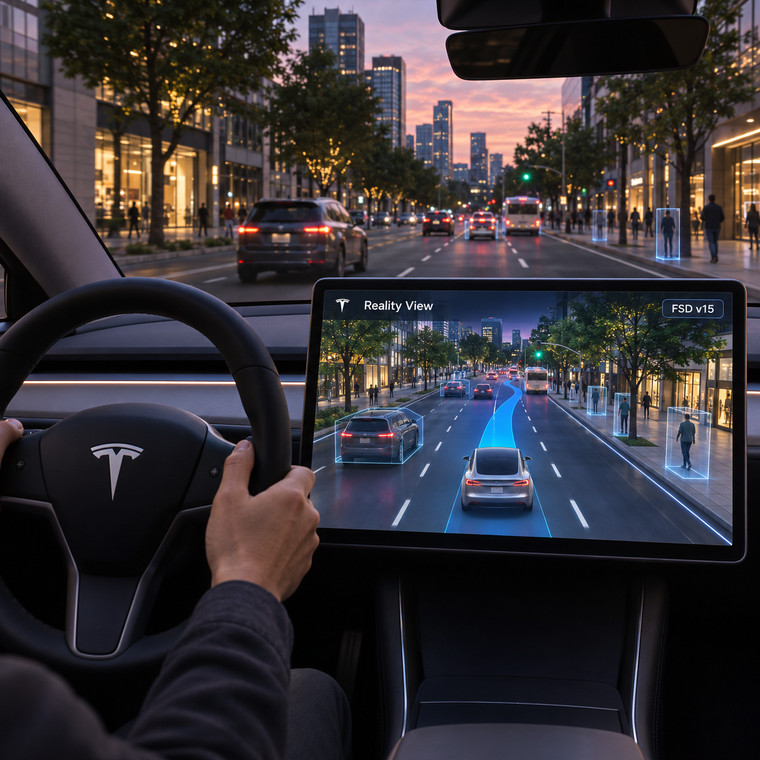
What Is Tesla Reality View, and Why Does It Look More Realistic?
Previous Tesla driving visualizations used simplified 3D graphics to represent vehicles, roads, lane markings, pedestrians, and other detected objects. With FSD v15, Tesla introduces Reality View, which uses AI to generate a more lifelike representation of the surrounding environment. Buildings, trees, roads, and nearby vehicles appear with significantly greater visual detail.
Unlike conventional camera displays, Reality View does not simply show footage from a single camera. Instead, AI generates a new view based on information processed from the vehicle's camera system.
For example, the display can show the surrounding environment from an elevated perspective above the vehicle, even though Tesla does not have a physical camera mounted in that position.
According to the FSD v15.0.1 Release Notes, Reality View also displays planned driving directions and supports different visualization layouts, including full-screen views and combinations of navigation maps and driving visualizations.
This represents more than a graphical upgrade. It introduces AI-generated imagery directly into the driving interface.
Gaussian Splatting: Turning Images into Realistic 3D Environments
In 2023, researchers introduced a technique called 3D Gaussian Splatting for Real-Time Radiance Field Rendering at SIGGRAPH 2023.
The research gained significant attention for demonstrating how images captured from multiple viewpoints could be reconstructed into detailed 3D environments and rendered efficiently.
To understand the concept, imagine trying to recreate a car in three-dimensional space.
One approach is to use thousands of small points to represent the vehicle's shape, including its body, windows, wheels, and roof. This type of representation is commonly known as a 3D point cloud.
However, a traditional point cloud may look incomplete because individual points can leave visible gaps.
Gaussian Splatting takes a different approach.
Instead of relying on simple points, it uses 3D Gaussian elements that contain information about position, size, shape, color, and transparency. When combined, these elements can produce a much smoother and more realistic image.
Think of it as the difference between drawing with individual dots and painting with carefully controlled clouds of color.
By combining large numbers of these elements, the system can reconstruct cars, buildings, trees, and other objects with impressive visual detail.
In the original research, the team demonstrated real-time rendering at 1080p resolution, achieving frame rates of 100 FPS or higher under their test conditions.
This breakthrough helped establish Gaussian Splatting as an important technique in modern 3D reconstruction and rendering.
Tesla Demonstrated Related Technology at ICCV 2025
The connection to Tesla became particularly interesting when Ashok Elluswamy presented the company's approach to autonomous driving at the International Conference on Computer Vision (ICCV 2025).
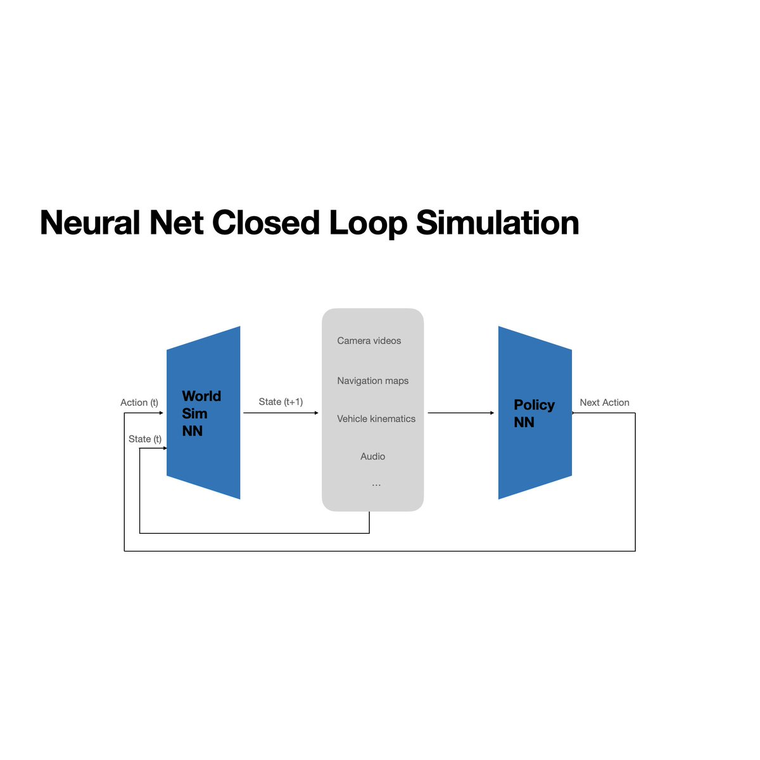
During the presentation, Ashok explained Tesla's End-to-End AI approach, which processes information from cameras, vehicle motion, navigation systems, and other sources to support driving decisions.
One of the technologies demonstrated was Generative Gaussian Splatting, which uses an AI model to generate 3D representations from vehicle camera data.
Traditional Gaussian Splatting methods generally require sufficient images from multiple viewpoints and an optimization process to reconstruct detailed scenes.
For a moving vehicle, obtaining complete visual coverage is challenging because the cameras primarily observe the environment as the car travels forward.
Tesla demonstrated an approach that uses AI to generate Gaussian representations more directly, reducing reliance on conventional initialization and optimization procedures.
The technique was also designed to represent moving objects within a scene.
This type of technology can help engineers visualize and analyze how an autonomous driving system responds to its surroundings, including changes in speed or interactions with obstacles.
The demonstration showed that Tesla had been exploring AI-generated 3D environments well before the introduction of Reality View.
However, it does not establish that the production Reality View system uses exactly the same method.
Does Reality View Actually Use Gaussian Splatting?
Although Reality View shares conceptual similarities with the technology demonstrated at ICCV 2025, Tesla has not confirmed that Gaussian Splatting is the primary rendering method used by Reality View.
Following the release of FSD v15, reports citing Elon Musk's technical explanation indicated that Reality View uses AI Video Generation, powered by a diffusion-based model with approximately one billion parameters.
The system uses information from Tesla's Vision Encoder, which processes visual inputs from the vehicle's cameras.
Rather than simply stitching together multiple camera feeds, the model generates new visual frames based on the processed information and previous frames, creating a continuous representation of the surrounding environment.
In simpler terms, the AI is generating an image of what the environment should look like from a particular viewpoint.
Gaussian Splatting and Reality View therefore belong to a broader area of AI-generated 3D visualization, even though the underlying techniques may differ.
A Tesla Owner Recreated a Similar 3D View Using Camera Footage
An interesting experiment reported by Not a Tesla App on November 23, 2026, demonstrated how footage from a Tesla Model 3 could be used to create a visualization resembling Reality View.
The experiment involved approximately 13 minutes of recorded footage from six vehicle cameras.
The footage was processed using Gaussian Splatting to reconstruct a three-dimensional environment.
Initially, the results contained visual inconsistencies, including blurred trees and objects appearing in incorrect positions.
The creator refined the reconstruction by comparing rendered images with the original camera footage and adjusting the 3D representation.
After approximately three hours of processing, the experiment produced a navigable 3D scene that could be viewed from different camera angles. Although the experiment did not operate in real time and did not use Tesla's actual Reality View system, it demonstrated how vehicle camera footage can be transformed into a detailed 3D environment.
It also highlighted the technical challenge of performing similar reconstruction continuously within a moving vehicle.
More Realistic Graphics with Less Computing Power?
Another notable aspect of Reality View is its reported computational efficiency.
According to Tesla's release notes, the new visualization system uses less overall computing power for rendering than the previous system, despite producing more detailed imagery.
In an analysis published on November 23, 2026, Electrek discussed Elon Musk's explanation that Reality View uses only a portion of the available AI4 computing resources.
The diffusion-based rendering model operates alongside the vehicle's existing AI processing systems.
However, Musk also acknowledged that the visualization still experiences some latency due to computational limitations.
This highlights an important challenge for Tesla: delivering increasingly sophisticated AI features while operating within the processing capabilities of vehicle hardware.
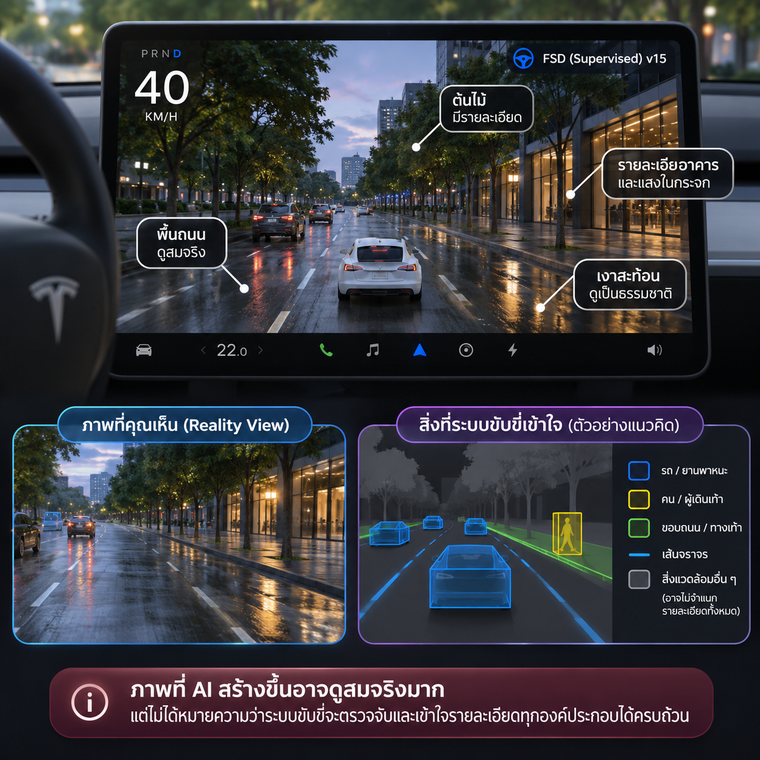
There is also an important distinction between what the AI generates visually and what the driving system actually understands.
Reality View may generate realistic details such as road textures, reflections, buildings, or shadows. However, this does not necessarily mean that the autonomous driving system has identified and interpreted every visual detail in the same way.
A realistic visualization is therefore not direct evidence of improved autonomous driving performance or safety.
Drivers must continue to supervise the vehicle and remain ready to take control when using FSD (Supervised).
When Will Tesla Owners in Thailand Get Reality View?
Tesla began rolling out FSD (Supervised) v15.0.1 to selected users in the United States on November 21, 2026, with Reality View among the major additions.
For Tesla owners in Thailand, however, there is currently no officially confirmed release date for FSD v15 or Reality View.
Another important consideration is hardware compatibility.
The initial release focuses on vehicles equipped with Hardware 4 (HW4/AI4). It remains unclear whether vehicles using the older Hardware 3 (HW3) platform will support the same Reality View experience.
Although Tesla reports improved rendering efficiency, this does not automatically guarantee compatibility with older hardware, as the system must still operate within the vehicle's overall AI processing capabilities. For Thai Tesla owners, the key questions are when the technology will become available locally, which vehicles will support it, and whether future software updates will introduce similar visualization improvements.
Reality View Is More Than a Visual Upgrade
From the introduction of Gaussian Splatting in 2023 to Tesla's AI-powered 3D reconstruction demonstrations in 2025 and the release of Reality View in FSD v15 in 2026, AI-generated visualization technology has advanced rapidly.
While Tesla has not confirmed that Reality View directly uses the same Gaussian Splatting approach demonstrated in earlier research, these developments illustrate a broader shift toward using AI to reconstruct and visualize complex environments from camera data.
Reality View represents an interesting step in how drivers interact with advanced vehicle software, offering a more detailed view of the environment and the system's planned movements. For Tesla owners in Thailand, the next developments to watch will be regional availability, hardware compatibility, and how Tesla continues to improve its AI-powered driving experience.
References
Tesla — Introducing Self-Driving V15
Inria — 3D Gaussian Splatting for Real-Time Radiance Field Rendering (SIGGRAPH 2023)
Ashok Elluswamy — ICCV 2025 Presentation
Not a Tesla App — FSD v15.0.1 Release Notes
Not a Tesla App — How Tesla's FSD V15 Reality View Actually Works
Electrek — Tesla FSD v15 and AI4 Compute Limit
Related content


